Monday, 24 October 2011

Brighton Pier

Borrowed a Nikon D50 from Finn O'Connell / Tom Mussett a little while ago, took it down to a quiet Brighton Pier for a spin...


This was insane. There must have been hundreds of birds (sparrows?) sitting on this rollercoaster, making a proper racket, all chirping away. For no apparent reason, they all suddenly stopped, fell silent and flew over my head. The contrast in noise from the chirping to the almost silent flutter of wings was bizarre.

Monday, 26 September 2011

Brighton Skateboarding


Ryan Lacy snaps his board from a height

When in Rome...

Lee Santer ruins a wedding photo session with a kickflip over the rail.


Thursday, 11 August 2011

Mama's Studio

Last September my mum (with help from Clive - a family friend who also happens to be a builder!) began building a studio at the bottom of the garden. She has been painting for a living since 2005, and desperately needed to create a space dedicated to her artistic process. She has been working in it for a couple of months now, and last time I was home I took my camera down there and had a little explore...

Vanessa Whitehouse is currently exhibiting at The Cork Street Open Exhibition.


Monday, 23 May 2011

Brighton Street Life

streetDrinker+
Found a sofa. Took it to the streets. Left to right: Pete, Si, Finn, Tom.

Wednesday, 13 April 2011

The derelict Royal Alexandra Hospital, Brighton


Explored an abandoned children's hospital a couple of weeks ago with Si and Finn. It's been derelict for about four years, so dissapointingly there's no surgical equipment or body parts left, and vandalism/nature have taken their toll. It's bizarre how a building can stand for over a century in (presumably) great condition and then a few years of neglect/abuse can have such a savage effect. Very photogenic though.

Brief history gleaned from Wikipedia:

The Royal Alexandra Hospital for Sick Children originally stood on Dyke Road. Brighton architect Thomas Lainson's red-brick and terracotta building, in the Queen Anne style, was opened by the Prince and Princess of Wales in 1881. It remained in use for more than a century before being replaced by a new building at the main Royal Sussex County Hospital site. The new facility opened in June 2007, and has won architectural awards for its innovative design.
The future of the Dyke Road site has been uncertain since the move to the new premises was first considered in 2001; Lainson's buildings and their later additions were threatened with demolition until 2009, when a developer was refused planning permission to replace the hospital with flats. Brighton & Hove City Council's latest planning briefs state that any redevelopment of the site should incorporate Lainson's original building.


Clicking makes 'em bigger!

Gaining entry was easy, the door at the top of the fire escape was open...

The children's ward, top floor

Lift shaft

Erm.. tramp residue...

Extremex Descaler

Debris

Storage shelves

Control Panel (for the operating theatre I think)

Entrance to what seemed to be the only operating theatre. 

Operating theatre. The photo doesn't really do the size of this room justice.

Finn in the operating theatre

The irony

Debris

The Blanche Ward

Stairway

The kitchen. Doesn't look like it was particularly clean when it was operational.

Fire alarm

Wednesday, 26 January 2011

Brighton Street Life

Buddhist sculpture at Brighton Street Market

Wednesday, 19 January 2011

Cyprus, October 2010


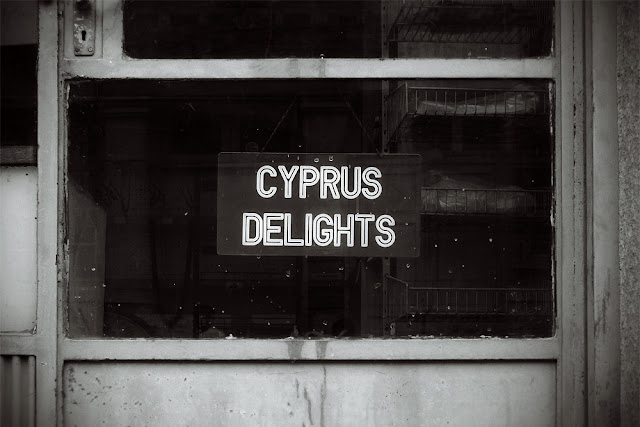
Sign in a shop window. Think Turkish Delights but slightly less tasty.

One of the first things I notice about Cyprus (after the heat and magnificent landscape) is how sparsely populated it is. Nothing is walking distance. Even the local corner shop is a short car journey away. I find that often, the key to conquering a foreign city is to master it's public transport system - usually the underground/metro/subway - thus giving you a much wider range of exploration. Yet as Cyprus is relatively small, there is no underground, or even overground. The privately run bus services are extremely poor, and the taxis prohibitively expensive. I'm not sure if this is cause or effect, but Cyprus has one of the highest vehicle ownerships per capita in the world - 742 cars per 1,000 people. (Though figures vary, even the same Wikipedia page contradicts itself)


Whenever I visit a new place I try to avoid the classic tourist destinations and clichéd photos of famous landmarks, instead attempting to see through the eyes of a local, exploring alleyways and back-streets. The downtown area of Limassol is currently undergoing an 18 million renovation project including "...restoration of underground utilities, construction of rainwater drainage system, reconstruct sidewalks, paving roads and strengthening of road lighting." In it's present state, there are still a large number of derelict and/or abandoned buildings, offering plenty of opportunity for one of my favourite photographic subjects.
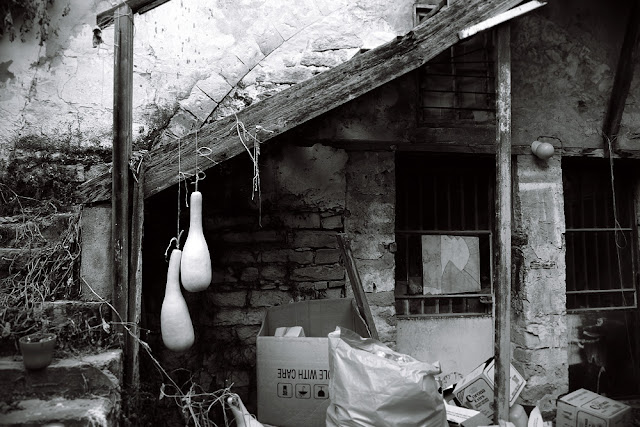
A pair of squashes hanging up round the back of a local bar.

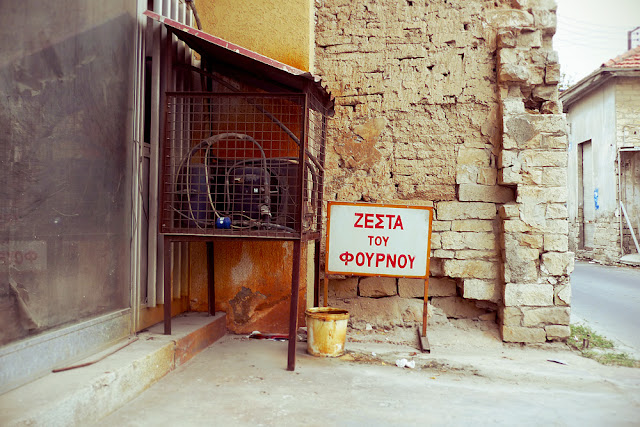
The sign translates as "Hot from the oven!"


I considered writing a brief history of Cyprus, but it's a little beyond the scope of this blog. If you're interested, there's a good summary here, that may help explain the above statement.

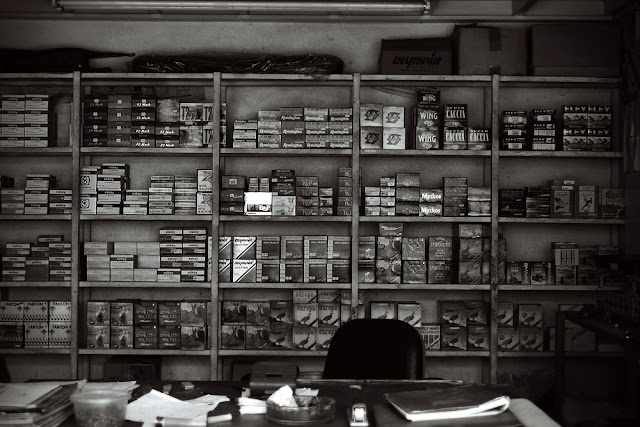
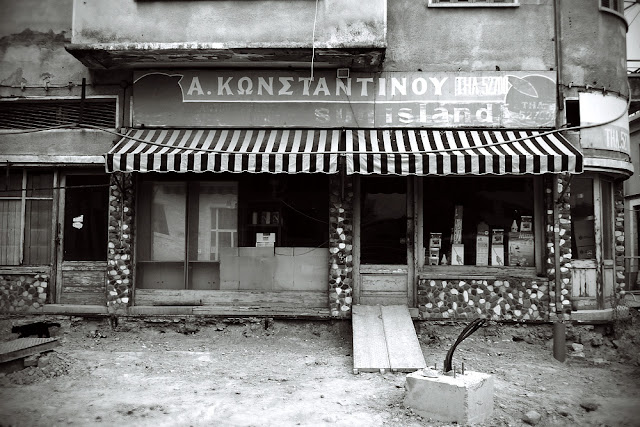
I'm not sure if they were closed for lunch, for the renovation or simply abandoned, but the following two photos are probably my favourite from the trip. They were both taken through the windows of shops in downtown Limassol.
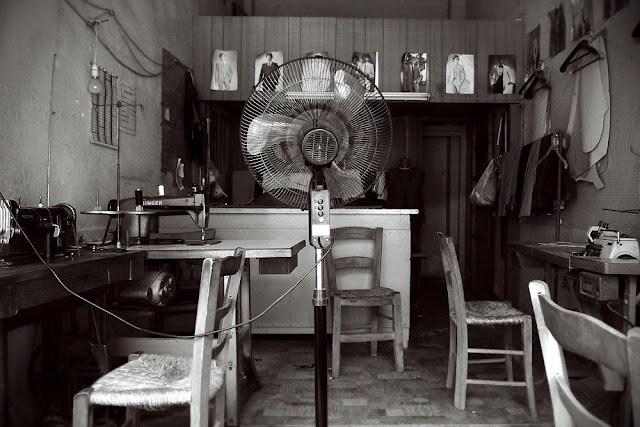
Tinker, tailor, soldier, sailor...

It was only after I shot this that I realised it was an ammunition store.

Cat.


The mythical birthplace of Aphrodite (Greek goddess of love) is just down the road from Pafos, now the spiritual home of thousands of pasty/pink English ex-pats and tourists (British gods of booze and sunburn). The seafront is littered with English bars and restaurants, and there's even a Pizza Express. Luckily, we only spent a couple of hours here before heading to a sleepy mountain village for the night.

Pafos, as seen from an otherwise pretty dull bottomless boat tour.

This is a regular sight in Cyprus. They're playing a fast-paced Greek version of backgammon called 'Tavli'


Centuries of deforestation and ever decreasing rainfall (around 480mm a year - compared to around 830mm in England) has led to severe water shortages, leaving much of the landscape extremely arid and barren. (There are parts that would make an epic background for some kind of dystopian post-apocalyptic film) On the way back from the village near Pafos, we stumbled across a deserted hotel complex called "Land of the Kings" surrounding a dried up old swimming pool:

A slightly redundant 'NO DIVING' sign
Flea market in Fassouri

Taken on my last day in Cyprus, overlooking Limassol from a pile of rocks on the marina.


I fear I may have painted an unfairly bleak picture of Cyprus. Though man's impact on the environment seems particularly prominent here, it is still a very beautiful country, especially in the mountains. I would highly recommend a visit, though suggest you hire a car!